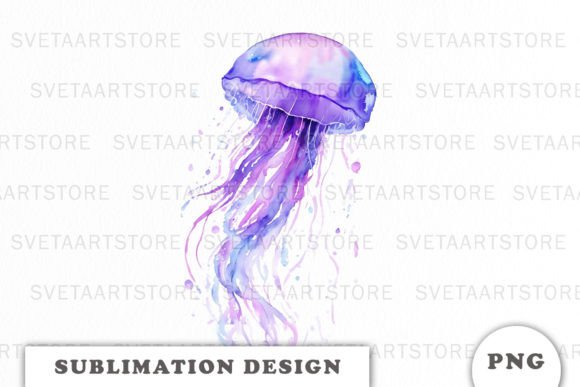
Watercolor Jellyfish Sublimation PNG
A Designer’s First Look: Soft, Fluid, and Full of Quiet Charm
When I opened Watercolor Jellyfish Sublimation PNG, my immediate reaction wasn’t “Wow—so detailed!” but rather, “This breathes.” It’s a hand-drawn sea life illustration with gentle washes, subtle granulation, and organic edges—no hard lines, no digital rigidity. That softness is its strength—and its biggest consideration for embroidery. As a designer who’s stitched hundreds of marine-themed pieces for boutique baby lines and coastal home goods, I knew right away this wouldn’t translate to dense fill-stitch jellyfish. Instead, it’s a mood piece: modern boho chic meets quiet ocean reverence. Think linen tea towels, organic cotton tote bags, or minimalist nursery pillow covers—not high-contrast gym apparel or busy festival patches.
Where It Shines: Real Projects That Feel Intentional
Last month, I used Watercolor Jellyfish Sublimation PNG as the centerpiece for a custom embroidered linen apron set—meant for a local ceramicist launching her studio shop. We converted it into a machine embroidery design with careful simplification: soft satin-stitch tentacles, open negative space in the bell, and a light fill-stitch base that mimicked watercolor bleed without overloading the fabric. The result? A finished product customers paused to touch, then asked about the story behind it. That’s the quiet power of this graphic—it invites connection, not just decoration.
It works especially well for:
- Personalized gifts like baby embroidery on organic cotton onesies (paired with a single delicate running-stitch tentacle)
- Tote bag design scaled to 4–5 inches wide, centered on natural canvas or heavyweight linen
- Holiday embroidery for coastal-themed stockings or gift tags—its gentle palette reads as calm, not kitschy
- Boutique branding when paired with clean typography in printable mockups for Etsy listings or craft fair displays
- Nursery decor stitched onto pillow covers or wall hangings where subtlety reads as sophistication, not lack of detail
Where to Proceed Thoughtfully
This isn’t a one-size-fits-all embroidery file. Its watercolor nature means fine gradients and soft transitions don’t survive dense stitching—or certain fabrics—without thoughtful adaptation. I’ve seen it struggle on:
- Stretchy fabric like lightweight knits: the fluid shape can distort unless stabilized heavily and stitched slowly
- Dark fabric without thread color testing first—the original PNG’s pale blues and lavenders fade visually if you default to navy or charcoal thread
- Curved surfaces like caps or curved baby hats: the jellyfish’s asymmetrical flow doesn’t wrap predictably, so placement needs extra mockup review
- Tiny hoop sizes under 3 inches: small details like tentacle tips lose definition; simplify before digitizing
- Frequent-wash items like kitchen towels or children’s clothing: avoid heavy fill areas unless using high-retention thread and proper stabilizer
What It Adds to Your Craft Business—Beyond Aesthetics
As an Etsy seller and small shop product developer, I pay close attention to how a design affects perceived value and buyer trust. Watercolor Jellyfish Sublimation PNG elevates handmade presentation because it feels curated—not mass-produced. Customers notice the difference between “cute jellyfish clipart” and something that looks like it belongs in a slow-living lifestyle magazine. That translates directly to willingness to pay more for a custom embroidered patch or personalized sweatshirt embroidery.
It also supports brand consistency for makers with a cohesive visual language—think coastal apothecaries, mindful parenting shops, or botanical studios. Used intentionally, it becomes part of a recognizable design vocabulary, not just a standalone graphic. And for digital product sellers, it’s strong source material for editable embroidery project bundles—especially when paired with matching stitch guides or color palettes.
Practical Embroidery Designer Notes
Before digitizing or stitching Watercolor Jellyfish Sublimation PNG, here’s what I always do:
- Test on scrap fabric first—especially your target fabric type and color
- Check thread color contrast by printing a black-and-white version: if values flatten too much, adjust saturation before digitizing
- Review stitch density manually—even if you’re outsourcing digitizing, request a low-density option for lightweight fabrics
- Confirm hoop size compatibility: does your intended placement fit comfortably within your standard hoop? Measure before finalizing layout
- Inspect small details at 200% zoom: tentacle ends, bell texture, and watercolor splatter should simplify cleanly—not disappear
- Compare light and dark fabric backgrounds side-by-side in mockups to guide thread selection
- Use proper stabilizer: tear-away for stable fabrics, cut-away for knits or stretchy blends
- Verify licensing before selling finished products or bundling as digital embroidery files—this is a Graphics asset, not automatically commercial-use
Final Thought: A Design That Rewards Intention
Watercolor Jellyfish Sublimation PNG won’t dominate a busy market booth—but it will make someone stop, smile, and say, “I need that for my seaside cottage.” It’s a Crafts asset with quiet confidence. Use it where softness matters, where handmade intention is part of the product story, and where your customer values feeling over flash. For embroidery designers and creative entrepreneurs, that kind of resonance is rarer—and more valuable—than perfect precision.