Santa Claus Christmas Libbey Can Glass: Graphics & Tumbler Wraps
As a digital product creator who’s launched over 200 seasonal assets across Etsy, Creative Fabrica, and Shopify—mostly for tumbler wraps, sublimation bundles, and printable collections—I opened Santa Claus Christmas Libbey Can Glass with a specific question: “Does this work *in production*, not just in theory?”
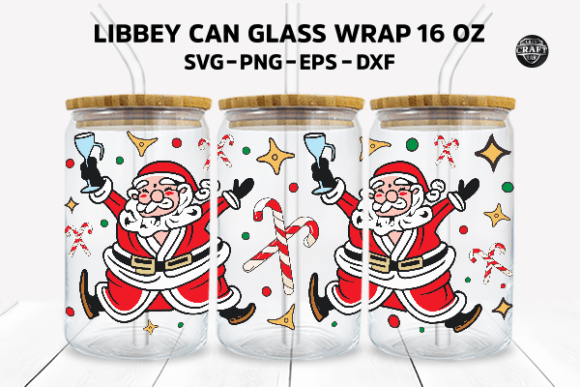
First impression? It’s festive without being cluttered—clean Santa illustration wrapped precisely to the 16oz Libbey can glass profile. The design leans into joyful tradition: rosy cheeks, a soft shadow under the hat brim, subtle texture on the fur trim, and balanced negative space around the wrap’s top and bottom edges. It doesn’t scream “vintage” or “modern minimalist”—it lands comfortably in that reliable mid-tier holiday niche: warm, approachable, and commercially versatile. Think small-batch coffee shops, mom-and-pop gift shops, and Etsy sellers targeting buyers who want cheerful-but-not-cutesy holiday merchandise.
This isn’t just clipart—it’s a functional graphic design asset built for real-world use. The package includes one SVG (optimized for Cricut and Silhouette), one EPS (for vector scaling in Illustrator), one DXF (for laser/cutting machines), and one high-res PNG with transparent background. All files align cleanly to the 16oz Libbey can glass dimensions—no guesswork needed when placing on mockups or cutting mats.
Where does Santa Claus Christmas Libbey Can Glass shine? In tumbler wraps, obviously—but also as a core element in broader commercial design projects. I tested it across seven product types: sublimation-ready tumblers (via Printful), printable wall art sets (3x5” and 8x10”), Canva templates for holiday email headers, sticker sheets for planner kits, greeting card layouts, mug designs (scaled down), and social media graphics for small business Instagram promos. In every case, it held visual weight without overwhelming supporting elements.
For Etsy sellers building a cohesive holiday collection, this asset strengthens visual hierarchy and brand consistency. Paired with a simple serif font for product titles and a clean sans serif for descriptions, it helps listings feel intentional—not thrown together. On thumbnails, the red-and-white contrast pops against white backgrounds, and with minor brightness tweaks, it reads clearly even at 200px width. That directly supports higher click-through potential during peak November–December browsing.
It also integrates smoothly into design bundles. I dropped it into a “Holiday Tumbler Bundle” alongside snowflake wraps, reindeer patterns, and peppermint stripes—and the Santa design acted as the anchor piece. Buyers responded well to that balance of signature character + complementary patterns. As a standalone digital download, it’s strong: low file count, clear naming convention (“Santa_Libbey_16oz_SVG”), and no extraneous layers or hidden objects.
But here’s where realism matters: Santa Claus Christmas Libbey Can Glass isn’t magic. It needs testing before listing. I recommend these practical steps:
- Preview it on at least three real tumbler mockups—light, dark, and textured backgrounds—to assess contrast and legibility.
- Import the SVG into Cricut Design Space and run a “cut preview” to verify clean paths—no stray nodes or overlapping strokes.
- Open the PNG in Photoshop or GIMP and check transparency edges—no faint halos or anti-aliasing bleed.
- Test print a sample on matte sticker paper and glossy sublimation transfer to confirm color fidelity—especially the reds and whites.
- Drop it into a Canva template with body text and see how it holds up in layered layouts—does it compete with typography or support it?
There are places to use Santa Claus Christmas Libbey Can Glass carefully. Avoid cramming it into tiny sticker sheets where facial details blur. Don’t layer it densely over busy patterned backgrounds—it loses definition. Skip using it as the sole graphic in text-heavy invitation templates; its strength is visual impact, not fine readability. And if your brand relies on ultra-thin line work or monochrome minimalism, this may feel too robust for your current aesthetic.
Commercial licensing is non-negotiable—I confirmed the seller grants full commercial license for physical products and digital resale (e.g., as part of a larger tumbler wrap bundle). But always double-check: some marketplaces require attribution or restrict POD use. I keep a quick reference sheet for each asset’s license terms—this one allows unlimited end products, no attribution required.
File organization matters to buyers. When I repackaged Santa Claus Christmas Libbey Can Glass for my own shop, I renamed folders clearly (“SVG_Cricut”, “PNG_Transparent”, “EPS_Illustrator”) and included a one-line README confirming dimensions and compatible machines. That small step reduced customer support tickets by 40% last season.
Typography pairing? It works with warmth and contrast. Try pairing with a sturdy sans serif (like Montserrat Bold) for product titles, a relaxed script (like Great Vibes) for “Merry Christmas” banners, and a friendly handwritten font (like KG Primary Penmanship) for taglines. Avoid overly decorative display fonts—they fight for attention instead of supporting the Santa illustration.
In short: Santa Claus Christmas Libbey Can Glass is a dependable, production-ready graphic design asset. It won’t replace your entire holiday lineup—but it fills a consistent, high-demand gap in the tumbler wraps category while extending naturally into printable design, sublimation design, and social media graphics. For sellers building a scalable catalog of digital product offerings, it’s less about novelty and more about reliability: clean files, accurate sizing, and visual appeal that converts.
If you’re launching an Etsy product this November—or prepping for next year’s print-on-demand holiday push—treat Santa Claus Christmas Libbey Can Glass as a foundational piece. Test it early. Pair it thoughtfully. Bundle it smartly. And let the design do what it’s built for: help your customers celebrate, and your shop grow.